
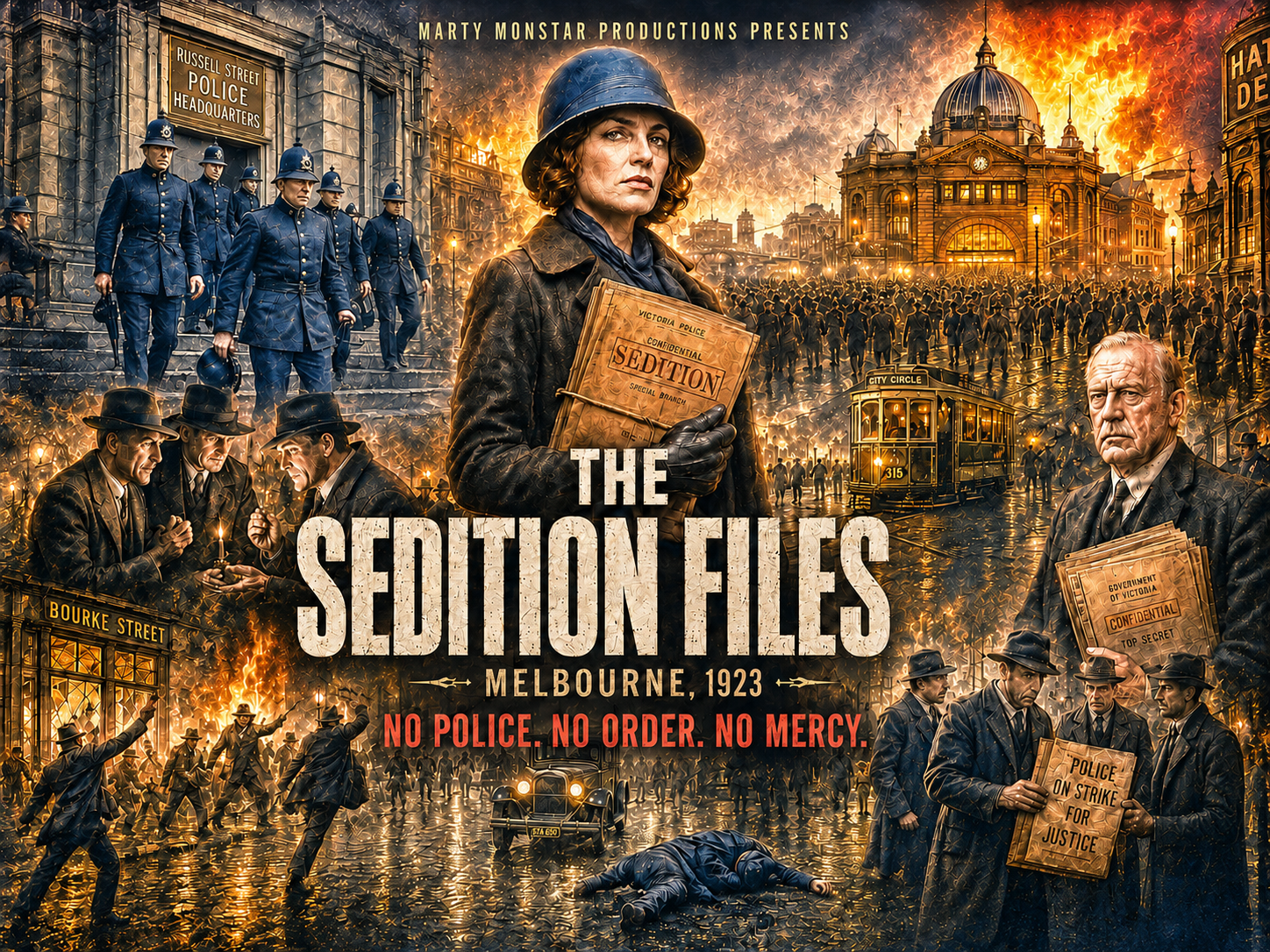
The Sedition Files

PLAY DETAILS

Melbourne, 1923. When more than six hundred police officers abandon the streets, the city descends into rioting, looting, fire and political paralysis. Private detective and seditionist Joan Archer unites rival underworld figures, agitates the strikers and turns public disorder into a weapon against those in power. But after Chief Commissioner Alexander Nicholson is executed in a laneway, suspicion begins closing around her. Inspired by the Victorian police strike, The Sedition Files is a sweeping historical crime thriller about lawlessness, political manipulation and the dangerous moment when an architect of chaos loses control of her own rebellion.

THEME

The Sedition Files explores corruption, political ambition, institutional power, civil disobedience and the fragile boundary between law and disorder. Central themes include loyalty and betrayal, justice and revenge, class conflict, gender and authority, manipulation of public unrest, and the personal cost of challenging powerful institutions. The play also questions who controls the truth when police, politicians and criminals all have something to conceal.

STRUCTURE

A full-length historical crime drama presented through chronological scenes set during the 1923 Victorian police strike. The action moves between police stations, government offices, city streets, criminal meeting places and Melbourne’s riot-torn commercial district. Private detective Joan Archer becomes entangled with striking constables, political leaders and underworld figures as tensions escalate from industrial dispute to public disorder. The converging storylines culminate in rioting, looting and the discovery of Chief Commissioner Alexander Nicholson’s body in a laneway, leaving Joan to uncover who exploited the strike—and why.

CHARACTER BREAKDOWN

• Joan Archer, 41 — Private detective, political agitator and criminal strategist.

• Billy Plumber — Young striking constable.

• Squizzy Taylor, Long Harry Slater and Snowy Cutmore — Rival underworld leaders.

• Alexander Nicholson — Chief Commissioner of Police.

• Harry Lawson, Stanley Argyle and John Monash — Political and civic leaders.

• Supporting ensemble — Police, gangsters, politicians and citizens.

HISTORICAL CONTEXT

The Sedition Files is set in Melbourne during the Victorian police strike of 1923. The dispute began on 31 October when police constables refused duty in protest against the use of labour spies and harsh disciplinary practices. By 2 November, more than 600 officers were on strike, leaving central Melbourne with severely reduced police protection. Crowds gathered in the city, and unrest escalated into rioting, looting and violent confrontations during the weekend of 2–4 November. Soldiers, special constables and civilian volunteers were called upon to restore order.

PRODUCTION HISTORY

Written by Marty MonStar, The Sedition Files is a sequel to The Ransom Letter and the second Joan Doris Archer story in the “JD Archer—Melbourne Without Law” series. The available text is the 2026 live-script version. It combines Joan Archer’s fictional criminal campaign with the historical events surrounding the 1923 Victorian Police Strike. Historical figures including Premier Harry Lawson, Chief Commissioner Alexander Nicholson, Stanley Argyle, Sir John Monash, Squizzy Taylor, Snowy Cutmore and Long Harry Slater appear within the fictional narrative. The play is structured in three acts and is suitable for professional, independent, community and fringe-theatre presentation. The production can be staged naturalistically or through an ensemble-driven theatrical style using projections, newspaper headlines, soundscapes and rapidly changing locations.

TECHNICAL REQUIREMENTS

A flexible 1920s Melbourne setting using modular scenery and period props. Lighting, sound and optional projections create streets, offices, riots and political unrest.

CONTENT ADVISORY

Recommended for mature teenage and adult audiences.

Contains coarse language, cigarette smoking, alcohol references, corruption, political intimidation, organised crime, civil unrest, rioting, looting, physical violence, threats involving weapons and references to murder. The play depicts confrontations between police, criminals, politicians and civilians during a period of widespread disorder.