
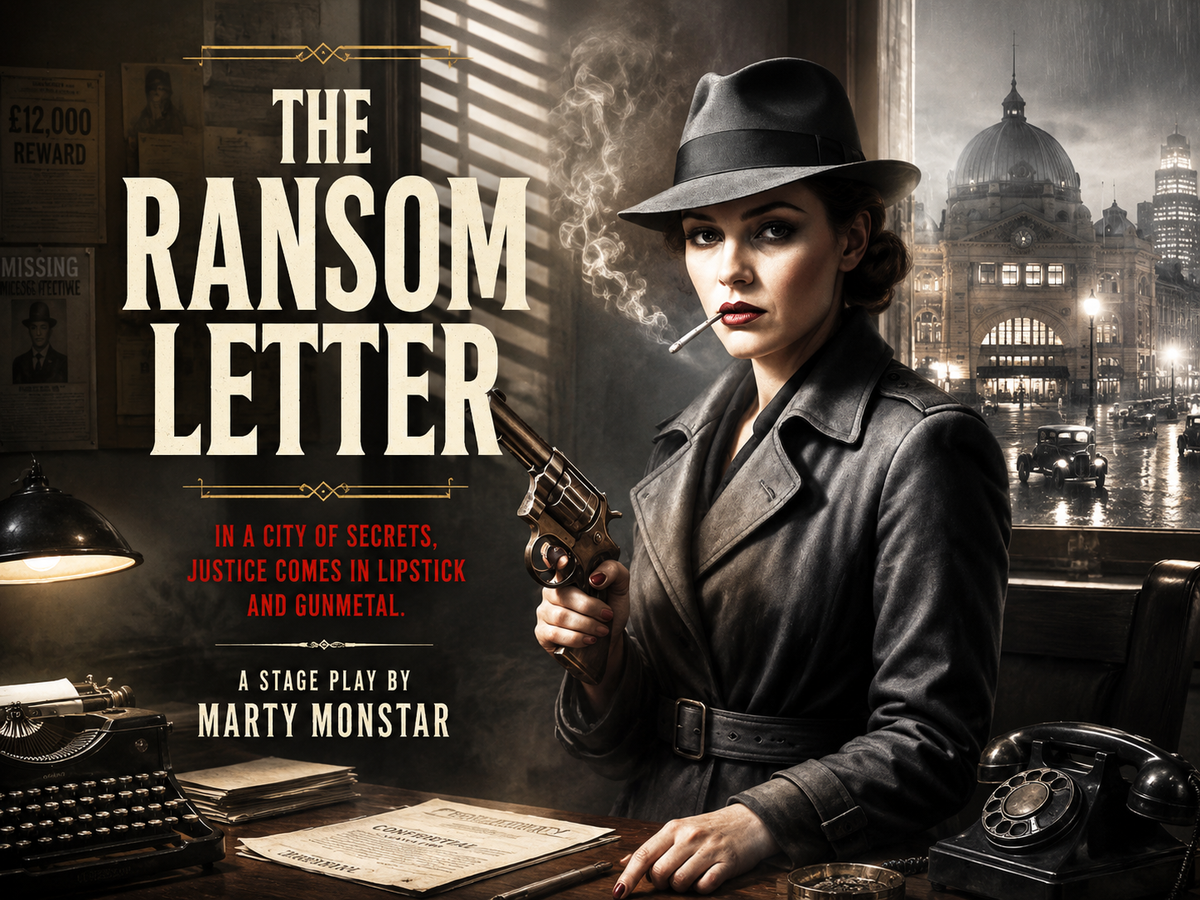
The Ransom Letter

PLAY DETAILS

Melbourne, 1922. Private detective Joan Doris Archer is drawn into a dangerous kidnapping when Prime Minister William Howie receives a ransom demand for his missing son. Guided—and frequently challenged—by the ghost of her detective father, Jack, Joan enters a shadowy world of criminals, political influence and buried family secrets. As the proposed exchange approaches, every ally becomes a suspect and the truth grows increasingly dangerous. The Ransom Letter is an atmospheric Australian noir mystery exploring corruption, betrayal, grief, revenge and one woman’s determination to deliver justice in a city governed by powerful men.

THEME

The Ransom Letter explores justice, corruption, grief, revenge and the destructive power of buried secrets. Central themes include loyalty and betrayal, political influence, gender and authority, family legacy, personal responsibility and the search for truth. Through private detective Joan Archer, the play examines the challenges faced by a determined woman operating in a male-dominated world where wealth and power can manipulate both the law and public memory.

STRUCTURE

A full-length, three-act historical noir mystery unfolding through chronological scenes and revealing flashbacks. The action moves between Joan Archer’s detective office, shadowed Melbourne streets, Joan's office and criminal meeting places. Joan’s investigation into a missing £12,000 and a mysterious ransom letter draws her into a dangerous network of political corruption, organised crime and unresolved family history. Appearances by the ghost of Joan’s father, Jack Archer, provide narration, memory and emotional insight as the investigation builds towards the exposure of a conspiracy involving some of Melbourne’s most powerful figures.

CHARACTER BREAKDOWN

• Joan Archer, 39 — Hard-drinking private detective.

• Jack Archer — Joan’s deceased detective father.

• Reggie Scuffins and Tommy Gruff — Joan’s underworld associates.

• Inspector Randell — Senior police investigator.

• William Howie — Prime Minister whose secret son is kidnapped.

• Squizzy Taylor — Melbourne underworld figure.

• Supporting ensemble — Police, politicians, clergy and criminals.

HISTORICAL CONTEXT

The Ransom Letter is set primarily in Melbourne in 1922, with flashbacks to 1917. The years following the First World War brought profound social change, industrial unrest, political division and the return of servicemen carrying physical and psychological injuries. Melbourne’s respectable public institutions existed alongside gambling, sly-grog establishments, illegal bookmakers and an expanding criminal underworld. Women had gained greater independence through wartime employment and political participation, but still faced significant professional and social restrictions. The play combines this historical atmosphere with fictional characters and events. Private detective Joan Archer, her investigation and the central conspiracy are dramatic inventions, while references to Melbourne’s politics, streets and underworld help ground the mystery in the period.

PRODUCTION HISTORY

Written by Marty MonStar and presented as a Marty MonStar Productions work, The Ransom Letter is an Australian historical noir designed for an intimate theatre setting. A version of the play has been presented at Club Voltaire in Melbourne. The available script is a September 2025 revision. The production can be staged with Joan’s detective office as a permanent central set, while lighting, sound and a small number of modular pieces establish the other locations. The combination of crime, political satire, supernatural storytelling and period atmosphere makes it suitable for independent, community and fringe theatre companies.

TECHNICAL REQUIREMENTS

A stylised 1920s noir setting with a desk, telephone and period props. Atmospheric lighting, sound and optional projections support location changes.

CONTENT ADVISORY

Recommended for mature teenage and adult audiences.

Contains coarse language, cigarette smoking, alcohol consumption, political corruption, intimidation, blackmail, references to kidnapping and wartime trauma, threats involving firearms, physical violence and murder. The play also addresses grief, family secrets, betrayal and the psychological consequences of past violence.