
Sir Percy's Conquest
PLAY DETAILS
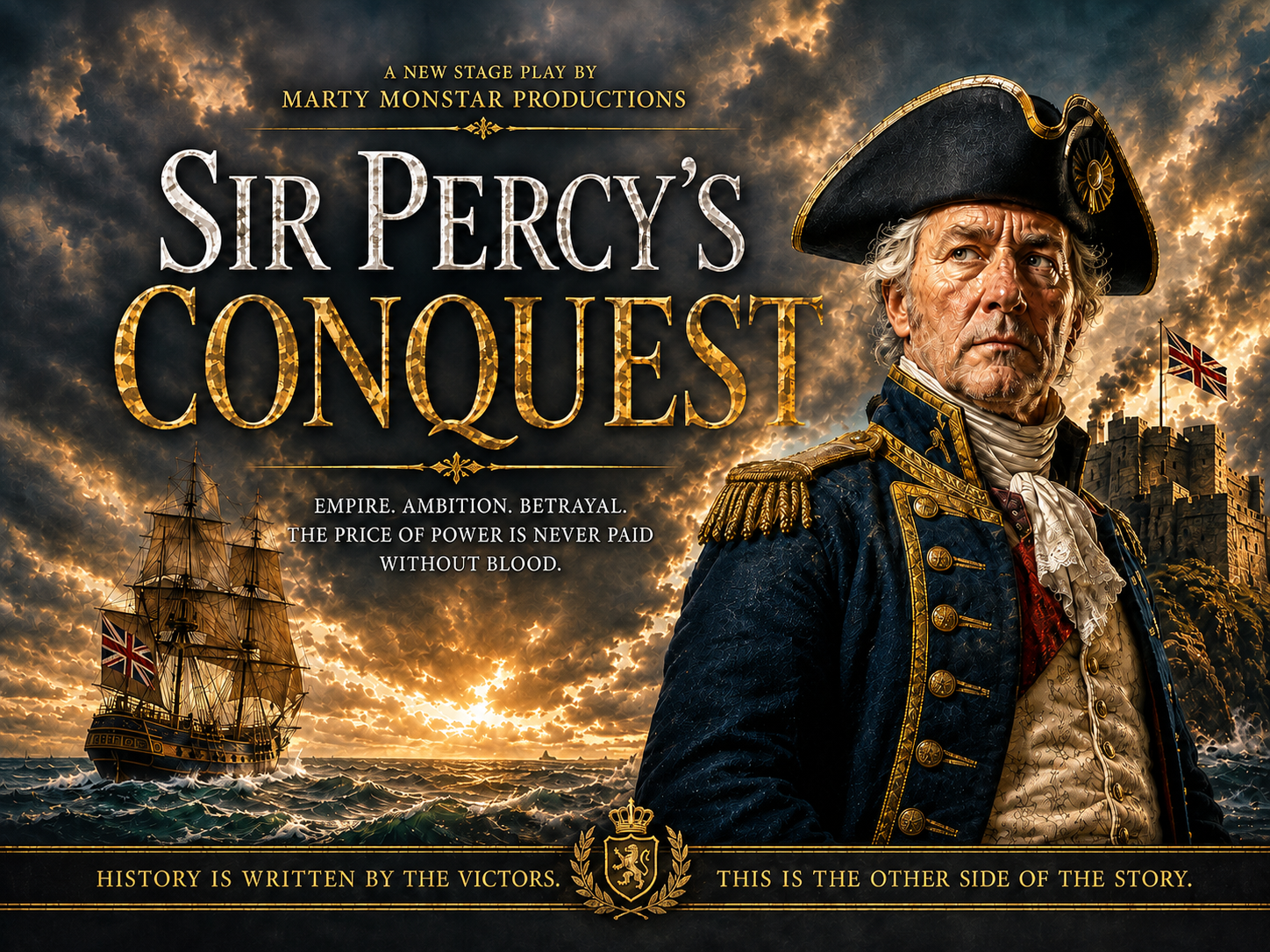
England, 1774. Charming aristocrat Sir Percy Cavendish enjoys a life of wealth and privilege while secretly operating as the elusive “Rose of the Valley.” With corruption spreading through the King’s Court and public executions providing entertainment and profit, Percy assembles his loyal crew for an audacious mission: disrupt an execution, raid the state’s coffers and defend those without power. Blending historical adventure, romance, satire and theatrical advertising, Sir Percy’s Conquest follows a witty gentleman outlaw risking his position and his life in pursuit of justice, freedom and the beautiful Adelaide Blenkinsop.
THEME
Sir Percy’s Conquest explores justice, freedom, loyalty, courage and resistance to corrupt authority. It examines class inequality, poverty, royal power and the difference between what is lawful and what is morally right.
Through Sir Percy’s secret identity as the Rose of the Valley, the play considers disguise, personal sacrifice and the responsibility of privilege. Friendship and romance accompany the political satire as Percy and his companions risk their lives to protect the innocent and challenge an unjust system.
STRUCTURE
A full-length historical comedy-adventure presented through a sequence of numbered scenes.
The action begins at Wallaton Hall in Nottingham before travelling through Captain Michael Goddard’s estate, Kensington, London’s streets, an execution ground and the court of King George III. Sir Percy Cavendish’s aristocratic life is contrasted with his secret activities as the masked Rose of the Valley.
A narrator guides the audience through the adventure. Bells, dulcimer music, horses, stagecoaches and other live or recorded sound effects create the Georgian setting. Comic product-placement interruptions, a product promoter and Foley performance add an intentionally theatrical and irreverent style.
CHARACTER BREAKDOWN
• Sir Percy Cavendish — Aristocrat and masked outlaw known as the Rose of the Valley.
• Percy’s companions — His loyal partners in rebellion.
• Government officials and soldiers — Representatives of the corrupt establishment.
• Family, townspeople and prisoners — Supporting ensemble roles.
HISTORICAL CONTEXT
Sir Percy’s Conquest is set in Georgian England in 1774, beginning at Wallaton Hall, Nottingham, on Sunday, 22 May. The story later moves to Kensington, London, Buckingham Palace and the fictional execution ground known as the Paddock of Hell.
Eighteenth-century Britain was marked by severe class inequality, widespread poverty and a criminal justice system that imposed execution for numerous offences. Public hangings were spectacles attended by large crowds, while prisons were frequently overcrowded and unsanitary.
King George III and recognisable Georgian institutions provide the historical background, but Sir Percy Cavendish, the Rose of the Valley and the central rescue mission are fictional. The play uses historical adventure, romantic comedy and political satire to examine injustice through a contemporary theatrical perspective.
PRODUCTION HISTORY
Sir Percy’s Conquest was written by Marty MonStar in 2019 and received its first public play reading at La Mama Theatre, Melbourne. The presentation used an ensemble cast, live narration, sound effects, music, Foley and comic period-style advertisements. The work remains available for further theatrical development and full production.
TECHNICAL REQUIREMENTS
A flexible period setting with adaptable scenery, costumes and essential props. Lighting and sound should support rapid location changes and action sequences.
CONTENT ADVISORY
Recommended for mature teenage and adult audiences.
Contains depictions and discussions of public executions, gallows, imprisonment, poverty, criminal activity, robbery, sabotage and physical violence. The play also includes alcohol consumption, sexual innuendo, bodily humour, irreverent advertising and satirical treatment of royalty, government and the justice system.